
Acid
On judgement, leverage, and restraint

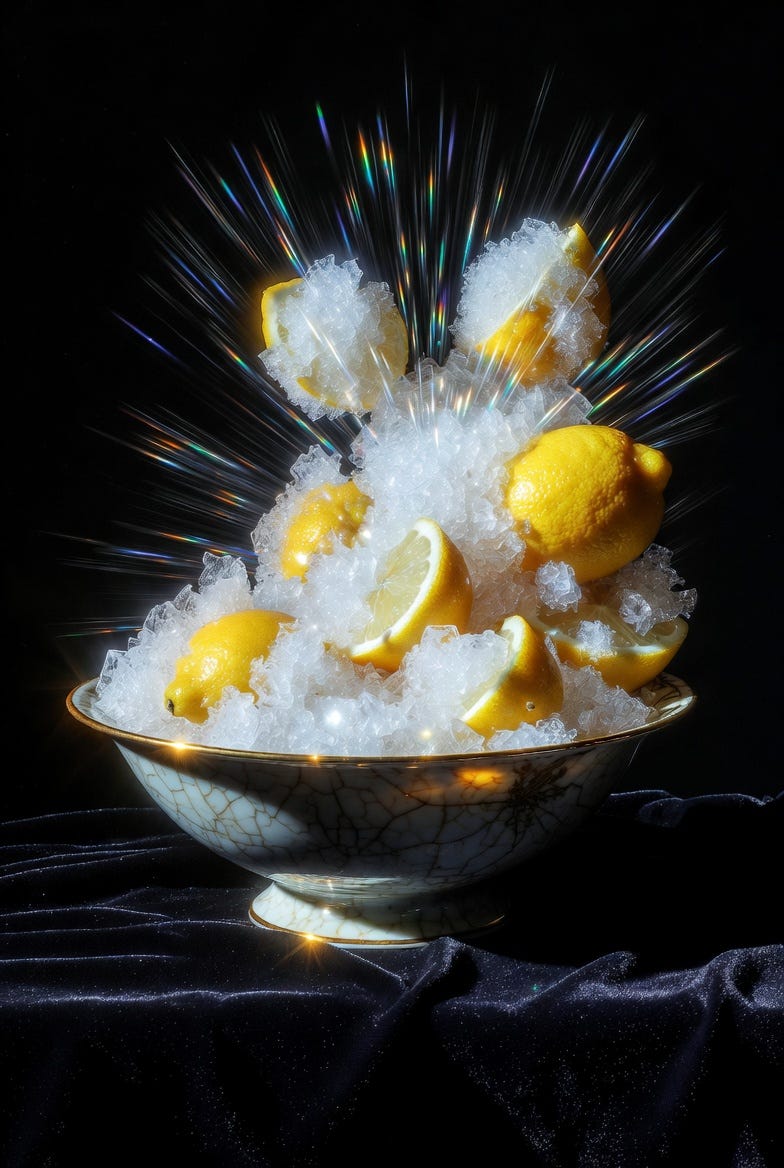
During my career in the various kitchens I’ve found myself in, acid was one ingredient that rarely inspired conversation. So I want to talk about acid. And for those alumni of the 1990s, no—we’re not talking about the substance that sends your brain into another dimension.
We’re talking about vinegar. Citrus. Acetic, citric, lactic acids.
The quiet back-up crew of the kitchen.
Of course, I knew what vinegar was. It was brown or white, malted or distilled. As a young boy it was used almost exclusively for chips. The smell of hot vinegar hitting a bag of fries still brings back memories of the seaside—an unexpected Friday night treat, or a cheap meal grabbed in the early hours after a beer-fuelled night on the town.
Even in my early years cooking, the only vinegar I really used was white wine vinegar. It went into mayonnaise to cure the eggs before the oil was added and the emulsion formed. It was splashed into a beurre blanc, or stirred through a salad dressing. We gave it no thought. The only requirement was that it was less aggressive than malt or distilled vinegar.
It wasn’t until I reached real kitchens—the Michelin-starred kind—that I started to hear phrases like the sauce needs cleaning up or the balance isn’t right. Chefs there kept vinegar on their station as part of their mise en place. But these bottles were different. The red wine vinegar was labelled simply Cabernet, Merlot, or Shiraz. The whites were Chardonnay and Sauvignon Blanc. The brown one was sherry.
These were actual wine vinegars.
I remember my first taste of Cabernet vinegar. It had viscosity. It was sharp, but not aggressive. The Chardonnay was almost sweet. And then there was my first real taste of balsamic. Until that moment, balsamic had meant something thin, sharp, and vaguely burnt with caramel. This was a different animal entirely—thick, almost syrupy. Sweet, but not sugar-sweet. The kind of sweetness only time can create. It was so good you could eat it with a spoon, I did.
The bottle was fifty years old. I was seventeen—an idiot, all answers and no questions. But I knew I was tasting something special, and for the first time, I did have a question:
Why were these vinegars so different?
And why were we using them at all?
Acid is a structural ingredient.
Think about it for a second and it makes sense.
Your tongue only recognises five tastes: salt, sweet, bitter, sour, and umami. Sour is acid. Not flavour, not aroma—structure. Acid is what you reach for when everything tastes heavy, dull, or wrong and you can’t quite explain why. It brings order to chaos. Balance to mayhem. And like a good friend who isn’t afraid of being unpopular, it tells you the truth when you need to hear it most.
Acid doesn’t flatter.
It corrects.
As chefs, we talk endlessly about flavour, but flavour is the last thing to arrive. Before aroma, before memory, before romance, there is structure. The palate responds to simple signals. These aren’t flavours—they’re measurements. Coordinates. When they’re in balance, the dish works. When they’re not, no garnish in the world will save you.
Acid sits at the centre of that system.
Salt seasons.
Fat carries.
Heat transforms.
Acid decides whether any of it makes sense.
Flavour—the thing people think they’re tasting—comes later, through the olfactory system, once the groundwork has already been laid. But we’re not here to talk about perfume. We’re here to talk about foundations.
Salt and acid are often mentioned together, and for good reason. Both stimulate saliva. Both wake the mouth up. Both sharpen perception. But where salt expands, acid cuts. Where salt rounds, acid defines. Salt can hide mistakes.
Acid exposes them.
Add too little and food tastes flat—lazy, unresolved. Add too much and it becomes aggressive, unwelcoming, impossible to ignore. Acid has no interest in subtle lies. It reveals imbalance instantly—not just in the food, but in the hand that applies it.
Which is precisely why so many people are afraid of it.
It isn’t fear of acid itself; it’s fear of understanding. Acid exposes ego, warts and all. Used without knowledge, vinegar becomes a blunt instrument—thrown in at the end to cover a mistake rather than correct it.
That’s not technique.
That’s panic.
So here’s the short version, without ceremony.
The science:
Acid lowers pH.
That’s it. That’s the trick.
On the plate, you feel it first, long before you understand it. Acid tames fat. It takes a heavy sauce and makes it lean, like it’s been to a personal trainer. It smooths chalky, dragging mouthfeel into something cleaner, silkier, more precise. It doesn’t add flavour so much as remove resistance.
But acid doesn’t stop at seasoning.
It goes deeper.
Lower pH environments are hostile to harmful bacteria. This is why acid has been used for preservation long before refrigeration or modern hygiene standards existed. It shortens curing times. It makes food safer. It buys you margin. That alone would justify its place in the kitchen.
But acid doesn’t just preserve.
It transforms.
When you introduce acid, proteins tighten and denature differently than they do under heat or salt. Fish firms without cooking. Vegetables soften without collapsing. Flavours sharpen without getting louder. Acid doesn’t add weight—it removes it.
This is why cured fish works. Why ceviche exists. Why a squeeze of lemon can rescue a dish drifting into excess. Acid doesn’t mask mistakes. It corrects direction.
Then there’s fermentation.
Lactic acid fermentation—sauerkraut, kimchi, yoghurt, pickles—is controlled decay. Sugars convert into lactic acid, pH drops, and an environment hostile to spoilage becomes friendly to flavour. What should rot instead ripens. What should fail instead becomes food.
This isn’t romantic.
It’s management.
Quick cures operate on the same principle. A splash of vinegar in warm vegetables. Lemon added at the end of cooking. Wine reduced into a sauce. These aren’t tricks. They’re interventions—small, deliberate adjustments that bring things back into balance.
Acid works best when it’s used late, gently, and with restraint. You can always add more. You can’t take it back.
That’s the rule people miss.
They’re not afraid of acid because it’s complicated. They’re afraid because it demands judgement. It asks you to taste, stop, think, and decide. No timer will save you. No recipe can finish the job.
Acid makes you responsible.
Responsible for choice. For intent. For knowing that lemon isn’t the only answer—grapefruit behaves differently, citric crystals differently again, each acid with its own temperament. There is no one-size-fits-all solution.
You need to understand the family before you reach for the tool.
The Families of Acid
Not all acids behave the same way, and treating them as interchangeable is how people end up with food that tastes sharp instead of balanced. Each acid has a temperament. Each one wants to be used differently.
Acetic Acid — The Corrector
This is vinegar. Wine vinegar, cider vinegar, malt, sherry, balsamic. Acetic acid is assertive. It doesn’t whisper. It announces itself immediately and lingers longer than most people expect.
This is the acid of correction. It cuts fat cleanly, resets the palate, and brings definition where things have gone soft. It’s excellent in dressings, pickles, and reductions, but it punishes heavy-handedness. Too much and the dish collapses into sharpness. Used properly, it brings clarity.
Good vinegars matter here. Wine vinegars carry the memory of the grape. They bring complexity rather than blunt acidity. Cheap distilled vinegar does the job, but it does it loudly. There are times for that. Just know the difference.
Citric Acid — The Brightener
Citrus—lemon, lime, orange—works fast and clean. Citric acid lifts flavours without staying too long. It brightens rather than dominates. This is why it’s often used at the end of cooking. A squeeze of lemon wakes everything up and then gets out of the way.
Citric acid doesn’t like heat. Cook it too long and it turns dull or bitter. It’s best used as punctuation, not structure. Think seafood, vegetables, light sauces. Use it early and it vanishes. Use it late and it sings.
Lactic Acid — The Builder
Lactic acid comes from fermentation and dairy. Yoghurt, buttermilk, crème fraîche, sauerkraut, kimchi. This acid is rounder, softer, more forgiving. It doesn’t cut so much as deepen.
Lactic acid is what makes sourdough satisfying rather than sharp. It adds tang without aggression and brings complexity over time. It’s the acid you live with, not the one that slaps you awake.
This is why fermented foods feel nourishing rather than exhausting. They don’t shout. They hum.
Malic Acid — The Green Note
Malic acid is found in apples, pears, and grapes. It tastes green and fresh, sometimes slightly sour, sometimes almost sweet. It’s what gives young wine its bite and fresh fruit its snap.
In cooking, malic acid shows up less directly, but it’s present in cider vinegar, apples used in savoury dishes, and certain wines. It’s crisp, refreshing, and short-lived. Think of it as acid with a pulse.
Tartaric Acid — The Skeleton Key
Tartaric acid comes from grapes and wine. It’s less obvious on its own but critical in wine-based cooking. It stabilises flavour, sharpens perception, and helps sauces feel complete rather than flabby.
When wine reduces well, it’s tartaric acid doing the heavy lifting. Without it, sauces taste heavy. With it, they feel finished.
So whats best for your larder.
So What’s Best for You?
At the supermarket, you’re not dealing with intention. You’re dealing with movement. What’s on the shelf is what sells, and vinegar, for most people, is an afterthought—something bought once, then forgotten.
You’ll find bottles labelled “red wine vinegar” with no mention of grape, origin, or age. “Balsamic glaze” thickened with sugar and caramel. “Apple cider vinegar” filtered until it’s anonymous. These products work. They won’t harm you. But they don’t give you leverage.
They’re designed to be inexpensive in cash terms, not in consequence. You use more of them. You correct more often. You compensate rather than decide. The cost isn’t financial—it’s attentional. It’s emotional. It’s spiritual.
They’ll tickle the taste buds for a moment.
But that isn’t a relationship. It’s a cheap one-night stand.
This is where people get price wrong.
Spending less here often means paying later. In effort. In adjustment. In dissatisfaction. What looks economical becomes expensive, just spread thin enough that you don’t notice it happening.
Buying better vinegar isn’t about luxury. It’s about alignment. A bottle that costs more upfront asks less of you over time. You use less. You think less. You trust more. It earns its place.
Cheap tools don’t just fail technically.
They train you to accept less than you need.
Now let’s talk about the serious players.
If you’re willing to spend a little more—or in some cases, a lot more—you gain something important: control.
Wine Vinegars Worth Owning
A proper wine vinegar tells you what it’s made from and how it got there. Grape variety matters. Aging matters. Oxygen matters.
Forum Vinegar (France)
Clean, restrained, unapologetically acidic. Made from specific wines and aged with intent. This is vinegar that corrects without shouting.Solera-style vinegars (Spain, Italy)
Fractionally aged like sherry. Younger vinegar gains depth from older batches. These are layered, rounded, and forgiving. You can reduce them, dress with them, even cook them gently without losing complexity.
These aren’t luxury items. They’re tools. You use less of them because they do more.
Balsamic: The Minefield
Most people think they’ve had balsamic vinegar. They haven’t.
What they’ve had is cooked grape must bulked out with wine vinegar and sugar, then rushed into a bottle. Sweet, sticky, loud. Fine on strawberries. Useless for balance.
Traditional balsamic—aged, slow, expensive—is a different substance entirely. Made from cooked grape must, aged for years in a sequence of barrels, evaporating, concentrating, deepening. It’s not sharp. It’s not sweet. It’s complete.
You don’t cook with it. You finish with it. A few drops. Respectfully.
This is acid that doesn’t correct.
It concludes.
Apple Cider Vinegar (The Honest One)
Unfiltered, cloudy cider vinegar with the “mother” still intact has a place. It’s lactic-adjacent, softer than distilled vinegar, useful for dressings, slaws, and fermentation. It’s not fashionable. It doesn’t care.
The Ones Most People Miss
There are a few vinegars that rarely get proper attention outside professional kitchens, and that’s a mistake. Not because they’re exotic, but because they solve problems Western vinegars don’t.
Chinese Black Vinegar
This is not a substitute for balsamic, despite what lazy comparisons suggest. Made from rice (sometimes wheat or millet), aged, fermented, and often smoked, black vinegar is deep, savoury, and quietly complex. It carries acidity, but also umami and warmth. Where wine vinegar cuts, black vinegar anchors.
It’s exceptional with rich meats, mushrooms, braises, and anything fatty that needs grounding rather than lifting. A few drops can add seriousness to a dish without brightening it. Acid with gravity.
Rice Wine Vinegar
Gentler, lighter, and less aggressive than Western wine vinegars. Rice vinegar doesn’t shout. It nudges. This makes it invaluable for vegetables, seafood, dressings, and pickles where clarity matters more than force.
It’s the acid you use when you don’t want to leave fingerprints. When the dish should taste clean, not corrected.
Seasoned rice vinegar, sweetened and salted, has its place too—but know what you’re buying. Neutral rice vinegar gives you control. Seasoned versions make decisions for you.
Sherry Vinegar
If wine vinegar grew up and learned restraint, it would be sherry vinegar. Made from sherry wines and aged in solera systems, it brings acidity, oxidation, and depth in equal measure.
This is a finishing vinegar. One that works beautifully with roasted vegetables, lentils, pork, eggs, and anything that wants warmth without sweetness. It’s assertive without being crude. You can taste the barrel. You can taste time.
Sherry vinegar doesn’t rescue a dish.
It completes it.
A Rule for the Larder
You don’t need twenty vinegars.
But if you cook often—and with intention—a serious larder looks like this:
A clean wine vinegar (red or white, grape variety named)
A rounded aged vinegar (sherry or solera-style)
A gentle vinegar (rice wine vinegar)
A grounding vinegar (Chinese black vinegar)
A sharp utility vinegar (for pickling and chips)
Anything beyond that is pleasure.
Which, as we’ve already established, is allowed.
This isn’t about abundance.
It’s about readiness.
Each of these acids does something different. Each solves a different problem. And once you understand that, you stop asking which vinegar is best and start asking what’s actually needed here.
That question matters far beyond the kitchen.
In conditions of constraint, people reveal themselves by how they spend what little leverage they have. In the camps, Frankl observed that the men who smoked their cigarettes rarely lasted long. The cigarette wasn’t comfort—it was currency. To smoke it was to spend tomorrow today. It wasn’t a moral failing. It was a loss of orientation.
Acid works the same way.
Thrown in carelessly, it’s waste. Used blindly, it’s panic. But held back, understood, and applied with judgement, it becomes leverage—the ability to change direction with very little force.
That’s true of food.
It’s also true of a life.
Acid stops being scary when you stop using it to cover mistakes and start using it to make decisions. When you learn to wait. To taste. To act only when the moment demands it.
That’s when acid stops being something you fear.
And starts being something you trust.
I never knew there were varieties of red and white wine vinegar. I’ve only recently begun to appreciate the use of vinegars, so I’m looking forward to putting this into practice.
Fascinating