
FIRE
Why We Keep Returning to Flame

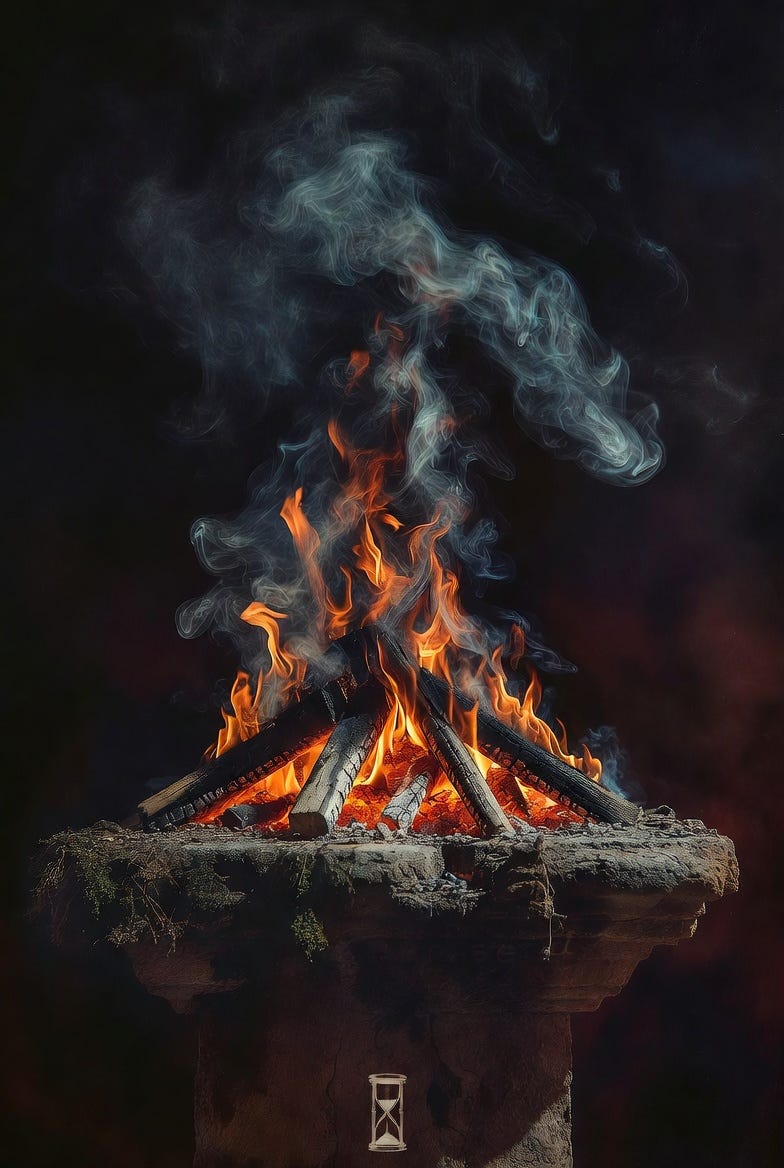
The first time I was trusted with the grill, I understood immediately why not everyone got that station.
Meat is expensive.
Unhappy customers even more so.
And fire does not forgive hesitation.
In professional kitchens, getting on the grill is a promotion. Only the top boys and girls. The chef has to trust you not to fuck it up. There’s no hiding there, no garnish to rescue you, no sauce to cover your mistakes. What you do is visible. What you ruin stays ruined.
The grill chefs were the coolest people in the kitchen, at least to my eyes. Forearms mapped with old burns like a record of past errors. Sweat dripping constantly as they worked. Eyes locked on the flame, never wandering. There was no room for distraction. Perfection was demanded, and perfection was delivered—or you were gone.
One Moroccan guy I worked with always opened his shift with the same line.
“I used to be white when I started here.”
That section was a furnace. Almost hell-like.
And yet no one wanted to leave it.
Because fire doesn’t allow you to hide.
It strips away theory, bravado, and excuse.
It leaves only presence.
Once fire touches flesh, there is no undo.
You don’t correct fire. You live with the result.
That’s the cost.
And only after you’ve learned that do you start to notice something else.
You don’t always encounter fire in chaos.
Sometimes it arrives in stillness.
I’m sitting at a restaurant table, waiting for my order. I’ve ordered this dish many times before and it remains one of my favourites. The menu describes it simply as cotoletta di maiale. Pork chop, for those unwilling to romanticise the obvious.
The meat comes from the Cinta Senese, a Tuscan heirloom breed known for its rich fat and sweet flesh. The chef has air-dried the chop in an old stand-up cooler for nine days. Those two facts alone tell you you’re about to experience something considered, not improvised.
Nine days of stillness. Nine days of the cold doing its slow, quiet work, pulling moisture out and intensifying what remains. It is a gamble of patience.
Outside, dark clouds gather over the lake. Not a polite drizzle—a real northern deluge, rolling in on invisible winds. Then the smell arrives.
Smoke. Caramel. Musk.
A faint bitterness, like coffee.
It hits the nose the way my wife’s perfume does after she has left a room—quietly, instantly—carrying with it the memory of why I love her in the first place.
The plate is set down. One thick-cut chop. A small dish of pure Tuscan salt. Nothing else demanding attention.
Of course the meat is excellent. But what matters more is how it’s been cooked. The fire is the final, brutal audit of those nine days in the dark. Grilled over hot embers—old olive branches, in this case. The char is exact, a thin, obsidian crust that protects the concentration of flavour the ageing provided. The heat doesn’t fight the age; it justifies it.
The fire did all the talking.
A life well lived.
Handled with care.
Served with restraint.
This is what fire becomes when it’s understood.
Not spectacle.
Not aggression.
But confidence.
Only someone who has been burned knows how to stand this calmly in front of it.
Why do we have such an affinity with fire?
Walk through an old town in Italy on a cold winter night and you’ll smell wood burning long before you see it. It hangs in the air, heavy and unmistakable. Someone will always say it—Oh, can you smell that? But what they’re really asking is something else entirely.
Can you picture the warmth?
The room.
The table.
The comfort.
The love.
Fire collapses distance between the physical and the emotional. A smell becomes a memory before you’ve had time to think. Smoke doesn’t just announce heat—it summons belonging.
We shouldn’t mistake mastery for a truce. The fire on the hearth and the fire in the hills are the same creature; one is just eating what we’ve offered it, while the other eats whatever it wants.
We know this.
California burns. Forests vanish. Towns disappear. Fire is not sentimental. It doesn’t care what we meant to build. It destroys without malice and without apology.
And still, we return to it—because even when we try to escape its raw power, we can’t escape the need for what it represents.
As humanity moves forward—trying to strip life down, renew it, optimise it, reimagine how we should live—fire remains constant. Even the most lab-grown, vegan-friendly, ethically massaged meat substitutes can’t resist it. They inject synthetic smoke flavour into the product and charge a premium for the privilege.
Fire sells.
Smoke comforts.
Even when the thing itself is artificial, the illusion of fire is still required.
My first experience with food cooked over fire came long before I knew any of this. Occasionally my father would wrap potatoes in tin foil and throw them straight into the coal fire. No ceremony. No timing. Just in they went.
They came out burnt beyond recognition. Charred skins. Flesh tasting unmistakably of coal. And to my young taste buds, they were magnificent.
I don’t remember the flavour exactly. But I remember the feeling. It felt like I’d witnessed a great warrior quietly reveal his secret move—the thing that wins the battle when everything else has failed.
Later, when I could actually cook—sixteen or seventeen, already four or five years into kitchen life—I cooked my first barbecue. Everything I thought I knew went straight in the bin. Along with most of the meat.
The coals were either too hot or too cold. Fat dripping from the meat caught fire, and the resulting flames gave everything a well-smoked finish—if by smoked you mean the inside of a chimney. Black. Acrid. Unforgiving.
Beside me stood an old hand working the pit. He had patience. He tried to guide me. The heat was oppressive, but he didn’t have a single bead of sweat on his brow. I moved like a shot rat—panicked, reactive. He moved like a heavy blade through water, sensing the current and simply leaning into it.
He didn’t fight the fire.
He spoke to it.
A gentle nudge of the poker and the flames rose. Another, and they settled. At times they danced high; at others they yielded, obedient as a well-trained dog coming to heel. Fire wasn’t something he controlled—it was something he understood.
That was the moment I saw why chefs keep returning to it. Fire is an interplay. Like a relationship. There is balance between you and it—but make no mistake where the real power lives.
Fire Does Not Negotiate
Fire is not a tool in the way a knife is a tool.
A knife waits. Fire does not.
When you cook over charcoal, you are not applying heat so much as entering a condition. Radiant energy pushes back. Air moves. Fat melts and falls away. Smoke rises and returns. The fire responds not to intention but to circumstance. What you meant to do is irrelevant. Only what you do now matters.
This is why fire feels alive.
Charcoal does not burn cleanly. It was once wood, already sacrificed once. Water driven out. Volatile compounds stripped away. What remains is concentrated energy, waiting for oxygen—stored consequence.
When the fire is lit, there is no pause. Time begins to matter. The surface of the meat dries. Proteins tighten. Sugars darken. Fat liquefies and drips into the embers, transformed again—into smoke, into aroma, into something that returns whether you want it or not.
The flavour of fire does not come from the charcoal itself. It comes from loss. From what leaves the meat and comes back altered. From fat becoming vapour. From moisture driven off. From the acceptance that something must be destroyed for something else to emerge.
Fire teaches this brutally well.
The Maillard reaction—the thing people speak of as if it were a trick—is simply what happens when heat meets flesh without apology. Water is removed. Structure collapses. New compounds form—hundreds of them. There is no improvement without exposure. No flavour without risk.
And once it begins, it cannot be undone.
This is why fire terrifies the inexperienced. You cannot negotiate with it. You cannot talk it down. The difference between char and perfection is not knowledge—it is attention.
Gas flame forgives.
Fire remembers.
Fat dripping onto embers sends smoke back toward the meat, carrying phenols, acids, bitterness, sweetness. The same act that creates depth can create ruin. The fire does not decide which. You do—by where you stand, when you move, whether you act or hesitate.
The young cook moves constantly, mistaking motion for control. The veteran stands still. He understands that every adjustment carries consequence, and that consequence arrives whether acknowledged or not. He knows fire rewards presence, not ambition.
Fire demands that you be there.
Airflow becomes judgement. A fraction more oxygen and the embers roar. A fraction less and they sulk. Heat zones emerge without permission. The fire is never uniform, never neutral. It offers possibilities, not guarantees.
This is why charcoal cooking feels ancient—not because it is primitive, but because it refuses abstraction. You cannot cook in the future over fire. You cannot cook in theory. You can only cook now, knowing that what you do closes off other possibilities forever.
Once the meat touches the grill, time begins to run out.
This is the truth fire teaches, quietly and without mercy: that every action is also a narrowing. That every decision excludes others. That meaning appears not in safety, but in commitment.
Fire does not promise success.
It promises reality.
And when the meat is pulled from the grill—transformed, irreversibly—what you are tasting is not just heat and smoke, but the record of attention. Of restraint. Of knowing when to act and when to let things be.
Fire does not care who you are.
But it reveals who you were willing to become in its presence.
That is why chefs return to it.
That is why it never gets easier.
And that is why, standing before fire, you are always already aware—whether you admit it or not—that time is finite, and that this moment will not come again.
Fire does not negotiate.
Fire doesn’t promise comfort. It promises reality. And in the kitchen, as in life, reality is the only thing worth serving.
My mother says about frying things-you are married to the stove-don’t walk away. An open flame is next level up from that.
This is why I live in Japan. Yakitori done over a charcoal fire is one of the most delicious, mesmerizing and affordable luxuries one can ever experience. Although, as a permanent expat, I will never divulge where my favorite places are for fear of the instagram locusts whom are unworthy of such perfection to experience. One must search this perfection out via trial and error (as your article outlines) to truly understand why fire, salt & meat (and also certain vegetables) are such transcendental comforts. Now I’m hungry 🤤