
TIME
On restraint, force, and knowing when not to move

“Time is on your side,” sang the thick-lipped, dancing grissino, Mick Jagger.
Unfortunately, it isn’t.
Time is not on your side. It’s moving whether you acknowledge it or not, taking things with it as it goes, and it has no interest in your intentions. If anything, time has been quietly kicking your teeth in since the day you were born.
But I’m not here to talk about time as decay, or loss, or the long shadow of death — not yet. I want to talk about time as an ingredient. One of the most powerful in the kitchen, and one most people barely notice until it’s already done its damage.
In a professional kitchen, time is not abstract.
It’s measurable.
Relentless.
Weaponised.
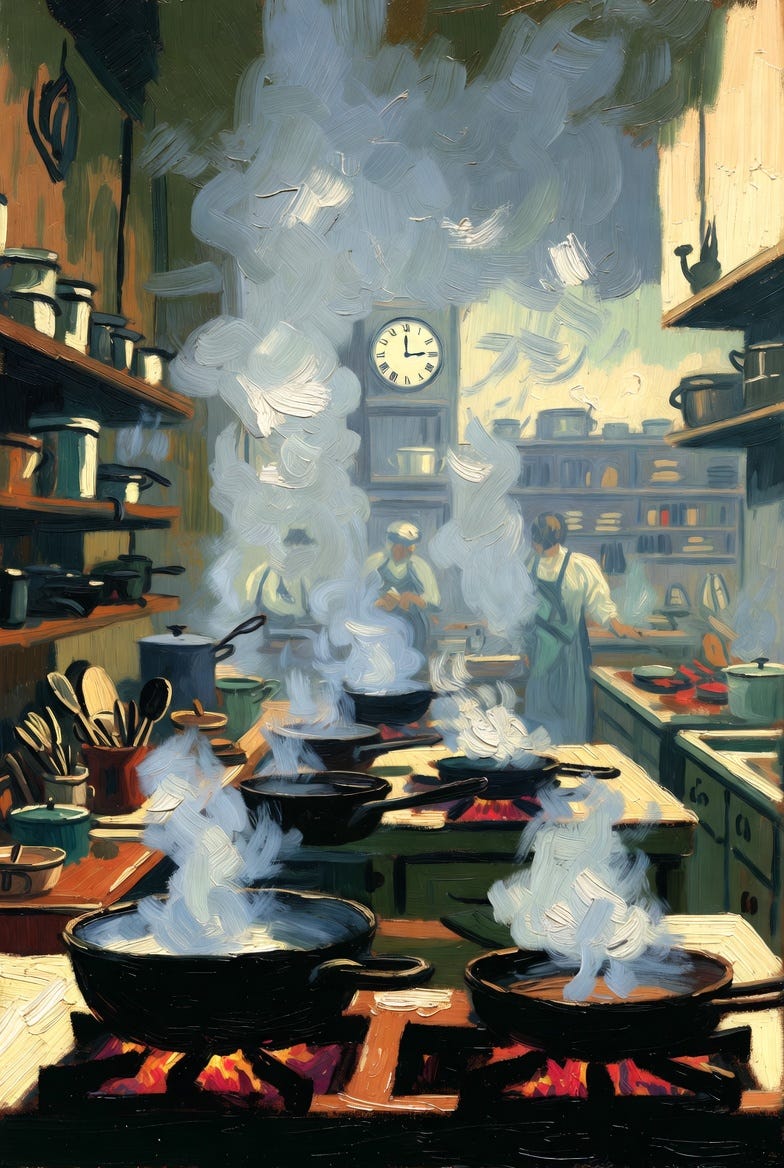
From the moment you walk through the door, you are on the clock. Arrive at 07:00. Orders checked and sorted by 07:30. Push hard until 11:30. Thirty minutes to reset, then service at twelve. Every section runs on timers — some cooks juggle five or six at once. Ovens, baths, reductions, ferments, rests.
There’s even a timer for the pass.
When the call goes up, the sixty-second clock starts. Miss it and the whole service collapses. Plates die. Food waits. Momentum is lost. One person’s failure becomes everyone’s problem.
So yes — chefs take time seriously.
Not because it’s poetic.
Because it’s unforgiving.
Time doesn’t just rule service. It governs everything worth eating.
My first real encounter with this abstract subject came when I was learning to cook fish. I was lucky enough to be taught by a proper old-school cook, the kind whose culinary lineage stretched back to Antonin Carême. For those who care about such things, that matters.
The first thing he said was simple.
“You see all these hot shots with their fish pans,” he said. “They don’t know how to cook unless the technique is handed off to something else. Listen, young fella — it’s heat, steel, and protein. In that order.”
He then watched me destroy a piece of fish.
I was pushing hard, constantly checking, trying to force a crisp skin. I moved it too early, too often. The result — like my pride — went straight in the bin.
“You wouldn’t feed that to a fucking dog,” he said.
Then he took over.
He lifted an old black steel pan — years of crusted fat, oil, and history baked onto it — and placed it on the stove. No oil. No fish. Just the pan.
“Very important,” he said. “The pan must be hot before you add any fat.”
He held his hand a millimetre above the metal.
“Feel the heat.”
I copied him and burnt myself. He smirked, probably remembering his first time.
“Now,” he said, “oil goes in. Not too much. You’re cooking the fish, not the pan.”
The oil spread and shimmered, a rainbow haze across the steel.
“Give it a minute,” he said. “Let it heat through.”
Then the fish went in, skin-side down. He placed two fingers gently on top to stop it curling. After a second, the fish accepted its fate and relaxed.
“Now we wait,” he said. “The fish will tell you when it’s ready.”
There was none of the frantic movement I’d shown. Just a man watching a piece of fish, palette knife in hand, waiting for permission.
“Look at the edges,” he said. “See them turning that creamy white?”
I nodded. To my young, untrained eyes the fish still looked raw.
He slid the knife under one corner. The fish released cleanly — crisp, intact. He flipped it, gave it a minute on the flesh side, then pulled it off the heat.
“Now it rests,” he said. “It’ll keep cooking while you get your garnish sorted.”
That was the lesson.
There is action even in inaction.
What matters is how you attend to the waiting.
I’ve taken more life lessons from that piece of fish than from most things I’ve been taught since — inside the kitchen and out.
Time is not just for the golden cowboy on the pass. Time affects everything: cakes, cures, stocks, doughs, eggs — all of them live or die by timing. Parmesan comes stamped with months: 12, 18, 24, 36. Each mark costs more, not because it’s rarer, but because time has been allowed to finish its work. The same is true of Parma ham, cured fish, fermented vegetables, even butter left quietly to culture.
This is where people get it wrong.
They think time makes things better.
It doesn’t.
Time makes things more themselves.
Handled properly, time deepens flavour, builds structure, creates meaning. Handled badly, it accelerates rot. Leave your egg fried rice out overnight, reheat it casually, and you’ll liquefy your insides faster than a laxative. Time didn’t improve it. It exposed your negligence.
This is the part people struggle with.
Time rewards restraint just as much as it rewards decisive action. Sometimes the right move is heat, pressure, force. Sometimes the right move is to do nothing at all — and to have the discipline to endure that waiting without interference.
That’s not passivity.
That’s control.
And the difference between the two is the difference between a cook who reacts and one who understands.
Time stands still for no one. And when I look at the world, I see timestamps everywhere — the pyramids, Stonehenge — but nowhere has time felt more present to me than Rome. Everywhere you move, you walk in the footsteps of heroes and villains. Beyond the city lie Etruscan caves, older still.
Nowhere, though, is time made more flesh — or in this case, bone — than in the Cripta dei Frati Cappuccini.
These men were so cool they had a coffee named after them. The cappuccino takes its name from the colour of the coffee and milk, which matched the colour of their habits.
If you visit their crypt, you’ll find what they’re truly known for. Bones. Thousands of them. Skulls arranged decoratively along the walls. Femurs stacked like architecture. It’s macabre. And strangely beautiful.
Each skull belonged to a person. Someone who woke up, worked, worried, laughed, failed, tried again. Someone who once had all the time in the world — until they didn’t.
The monks don’t let you miss the point. There’s a small plaque on the wall that reads:
What you are now, we once were.
What we are now, you will become.
It’s not a threat.
It’s not a warning.
It’s an accounting.
You’re reminded, gently but firmly, that time is infinite — and you are not. That the days you waste don’t roll over. That the responsibilities you avoid don’t disappear. That meaning doesn’t arrive eventually. It has to be extracted, deliberately, while you’re still here.
When you leave, you stop for a coffee. A cappuccino. Warm. Comforting. Milk softened by heat. A small daily ritual named after men who lived surrounded by bones, fully aware of where all rituals end.
That knowledge doesn’t ruin it.
It deepens it.
Around the corner sits La Campana, an old-school Roman institution where someone has eaten continuously since 1518. Caravaggio ate there. He had taste. He couldn’t have ordered a cappuccino — it wouldn’t exist for another five hundred years — but the point remains.
People pass through.
Places endure.
Someone else will sit where you sit.
I finished my coffee.
Then I ordered another.
Time didn’t stop.
But for a moment, I paid attention.
Here’s a quick recipe for Tirimisu
Tiramisù (A Recipe About Waiting)
Serves: 6
Time: 20 minutes work + overnight rest (non-negotiable)
Ingredients
4 large eggs, very fresh
100g caster sugar
500g mascarpone
300ml strong espresso, cooled
2 tbsp Marsala or dark rum (optional, but recommended)
Savoiardi (ladyfingers), as needed
Unsweetened cocoa powder
Method
Separate the eggs
Yolks in one bowl, whites in another. No mercy for broken yolks.
Yolks and sugar
Whisk the yolks with the sugar until pale, thick, and noticeably lighter. This isn’t about air — it’s about dissolution. The sugar should disappear.
Mascarpone
Fold the mascarpone gently into the yolk mixture. No beating. If it splits, you’ve rushed it.
Whites
Whisk the egg whites to soft peaks. Not stiff. Not proud. Soft.
Fold them into the mascarpone mixture carefully. This is where restraint matters.
Coffee bath
Mix the cooled espresso with the Marsala or rum.
Dip the savoiardi quickly — in and out. If they soak, you’ve ruined the structure.
Assemble
Layer biscuits, then cream. Repeat once.
Finish with cream on top. No decoration yet.
Wait
Cover and refrigerate overnight.
This is not optional. Time does the work you can’t.
Finish
Just before serving, dust generously with cocoa.
Not earlier. Cocoa absorbs moisture and turns bitter if left too long.
I’ve only ever made a cheat’s tiramisu with ricotta and cream cheese, but I cannot wait to get into my kitchen and make this recipe. Yes, I get the irony.
That plaque in the Cripta dei Frati Cappuccini has always given me chills.
Time doesn't stop. Time doesn't care.